What Nucleus Actually Does: An Engineer's Guide to Whole Genome Sequencing
For the last couple of years I’ve been the CTO at Nucleus. Most people haven’t heard of Nucleus, or aren’t sure what it actually is. So here’s my practical take, from an engineer: what it is and how it works.
TLDR
You swab your cheek. We sequence all of your DNA. From that, we tell you your risk for over 2,000 diseases, and what diseases you might be a carrier for.
If your partner does it too, we can give you a combined carrier-screening result where we compute the likely disease risks for your future kids.
Finally, if you’re doing IVF (which a doctor might recommend based on the above), we can tell you a bit more about each embryo.
That’s the product. Now, if I may be so bold, I would say we are the broadest HIPAA-compliant whole-genome health and carrier-screening test available in the United States. Here’s how it actually works.
What “whole genome” actually means
Your genome is about 3.1 billion characters long, written in a four-letter alphabet (A, C, G, T), and you have two copies: one from each parent.
Between any two living humans, DNA is about 99.9% the same. The interesting part is the other 0.1%. It sounds tiny, but 0.1% of 3.1 billion is still around 3 million letters, and it’s where nearly everything we look for lives. Compared to the standard human reference genome, a typical person differs at roughly 4 to 5 million positions. Almost all of those differences are harmless. The ones we care about are a tiny subset.
What’s a variant?
A variant is any spot where your DNA differs from the reference genome. We engineers call this a “diff”. In the diff analogy, each variant is one changed line. Geneticists say “variant” rather than “mutation” because most differences are normal human variation, not damage.
Variants come in a few sizes:
- Single-letter changes (SNVs): one letter swapped, e.g. a G where the reference has an A. These are the large majority.
- Small insertions and deletions (indels): a few letters added or removed.
- Structural variants: larger chunks deleted, duplicated, or rearranged.
Because you have two copies of your genome, you can carry a variant on one copy or on both. That distinction matters a lot for carrier screening, below. Almost all of your variants are harmless; a variant that disrupts a gene enough to cause disease is called pathogenic.
Reading the whole thing
Consumer DNA tests like 23andMe or Ancestry.com don’t read your genome. They use a genotyping array: a chip that checks a fixed list of roughly 600,000 to 700,000 known positions. That’s about 0.02% of the genome. It’s good for ancestry and a handful of well-known variants, but if your important variant isn’t on the list, the chip can’t see it. Rare variants, which are exactly what cause most single-gene diseases, are mostly not on the list.
Whole genome sequencing (WGS) reads everything. If you think of the reference genome as a file, your genome is a diff against it, and WGS gives you the whole diff instead of spot-checking a few hundred thousand lines.
(While we’re on it: we don’t do ancestry reports. That’s what those other tests are known for, and it’s not our focus. Nucleus is about health: we’re like your doctor’s office, and we’re HIPAA-compliant.)
What happens after the swab
The pipeline will look familiar to anyone who’s built a data pipeline:
- Sample collection. You swab your cheek at home and mail it back. Cheek cells carry the same DNA as the rest of your body.
- Extraction and library prep. The lab pulls the DNA out, creates short fragments, and tags them so the sequencer can read them. This happens in a CLIA-certified, CAP-accredited clinical lab (more on what that means below).
- Sequencing. We use 30x short-read sequencing. The sequencer reads each fragment, about 150 letters at a time, hundreds of millions of times over. “30x” means each position in your genome is read about 30 times on average. Redundancy is how you tell a real variant from a sequencing error. The raw output is on the order of 100 GB.
- Alignment. Each short read gets placed where it belongs in the reference genome. This is the giant-jigsaw-puzzle step, and it’s computationally heavy.
- Variant calling. Looking at the stacked-up reads at each position, we decide where you differ from the reference, and whether you have that difference on one copy or both. The output is a VCF file, which really is a diff: a few million rows of “at position X, reference says G, you have A.”
- Annotation and interpretation. This is where we turn a diff into health information. For each variant: which gene is it in, what does it do to the protein, how common is it, and what does the medical literature say about it?
- The report. You see the results that matter, organized by condition, with what to do next.
Steps 1 through 5 are mostly a solved, industrialized problem. Step 6 is where the real work is, so it gets its own section.
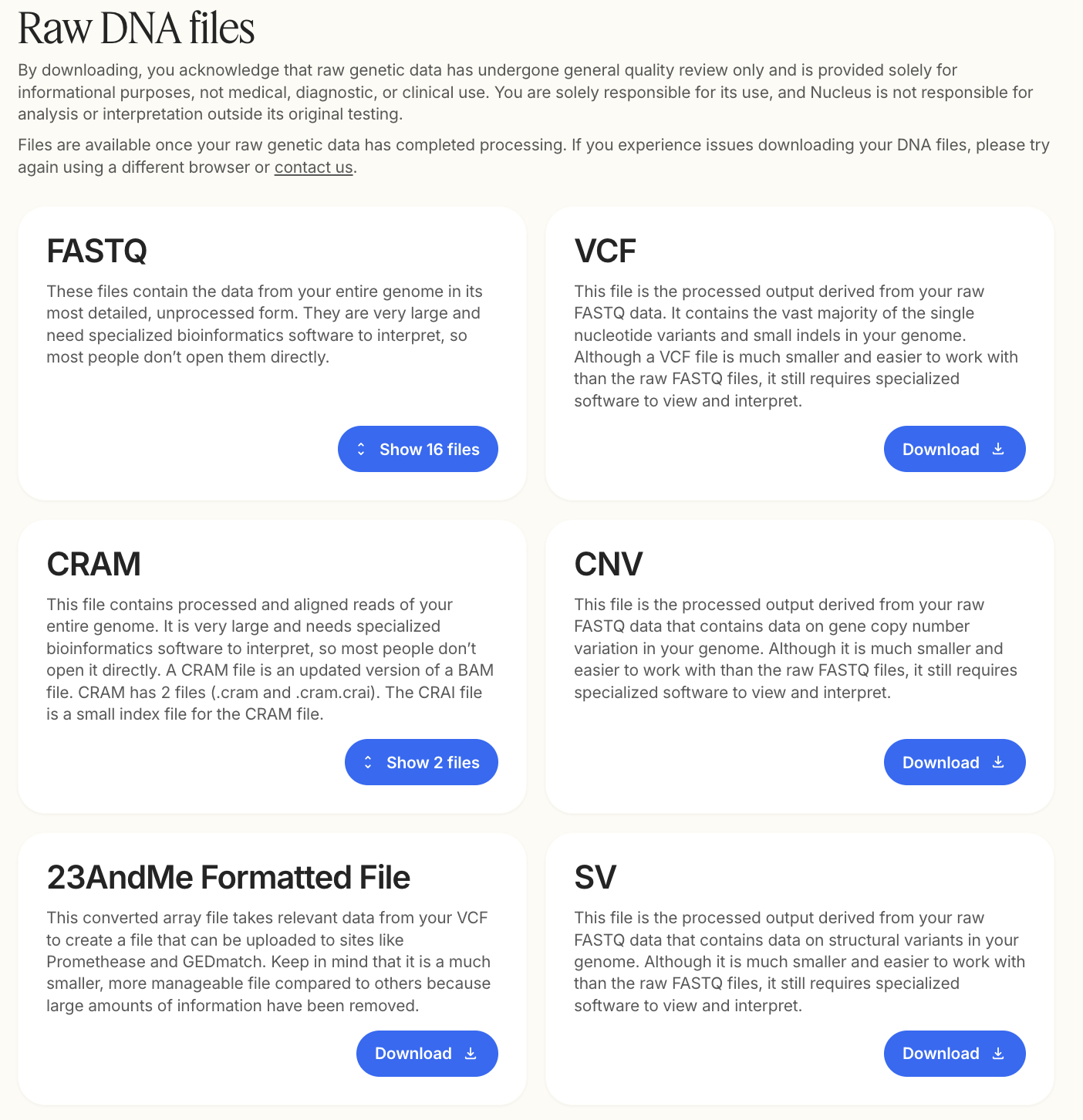
You can download all of it
Your data is yours. As soon as your results are released, you can download every file from your Nucleus account, and there’s a lot of it:
- Your physician report: the clinical results as a PDF, signed off by our lab director, which you can share with your doctor or a genetic counselor.
- FASTQ: the raw reads straight off the sequencer, hundreds of millions of 150-letter fragments, each with a quality score for every letter. Mine came as 16 files.
- CRAM: those same reads after alignment, compressed against the reference genome, plus a small
.craiindex. This is the file you’d use to look at the evidence behind any single variant. - VCF: the diff itself: your single-letter changes and small indels.
- CNV and SV: the bigger variants, copy-number changes and structural variants, each in its own file.
- A 23andMe-formatted file: a cut-down version of your VCF that you can upload to sites like Promethease or GEDmatch.
I’ll write a future post about how you could try analyzing these files yourself. It’s a fun project for an engineer. But for disease reports, you can trust that we’ve already done the most extensive, up-to-date analysis available, run through our CLIA-certified, CAP-accredited lab. Our polygenic risk scores are cutting edge, and we have scientists whose job is developing them. And yes, we use cutting-edge software and tools to give you the best results possible.
From a few million variants to a report
Out of the 4 to 5 million places you differ from the reference, a report might contain a handful of findings. Getting there is a process of filtering: separating the few differences with solid medical evidence behind them from the millions that are harmless or not yet understood.
Classification. Every candidate variant gets classified under the standard clinical framework (the ACMG/AMP guidelines) into one of five buckets: pathogenic, likely pathogenic, uncertain significance, likely benign, or benign. The evidence comes from population frequency (a variant that 5% of healthy people have isn’t causing a rare disease), what the change does to the protein, published studies, and clinical databases.
We don’t report variants of uncertain significance. A VUS means “we don’t know yet.” For any given person we’ll find variants nobody has seen before, or that the literature disagrees about, and a lot of rare variants land in this bucket. Reporting them would mostly create anxiety, and sometimes unnecessary medical follow-up, over something that usually turns out to be nothing: when VUS do get reclassified, most end up benign. So we report pathogenic and likely pathogenic findings, and hold the rest.
A human signs off on every reported variant. Our lab director reviews and signs off on every variant that goes into a report. Engineers can think of it as a required code review on the path to production: the pipeline proposes, a qualified person approves, and nothing ships without that approval.
Knowledge changes, your genome doesn’t. A variant that’s uncertain today might be reclassified next year as new research comes out. That’s a nice property of WGS from an engineering point of view: the sequencing data is immutable, and the interpretation is a versioned function you can re-run as the knowledge base improves. We review variants periodically, and re-analysis is included in our yearly subscription: as long as you’re subscribed, we keep re-analyzing your results as new research and updates come in. You sequence once; the report keeps getting better.
Your own health risks
The 2,000+ conditions fall into two different kinds of analysis.
Rare, single-gene (monogenic) disorders. One gene, one variant, and it can make a big difference. These are rare individually, but there are thousands of them, so together they aren’t rare at all. The classic example is BRCA1: a harmful variant raises a woman’s lifetime breast cancer risk from about 13% to something like 55–72%. This is where the classification process above does its work.
Common, complex conditions like many cancers, heart disease, and diabetes. These aren’t caused by one gene. Hundreds to millions of variants each nudge your risk a tiny bit. The tool here is a polygenic score, which, to an engineer, is just a weighted sum: for each relevant variant, multiply how many copies you have by its weight (learned from large studies), and add them up. The result tells you where you sit relative to a reference population, e.g. “top 5% of genetic risk for coronary artery disease.”
These two kinds of results mean different things, and the report keeps them separate. A monogenic finding can be close to definitive. A polygenic score shifts the odds: a high score means higher risk than average, not that you’ll get the disease, and a low score doesn’t mean you can skip the checkup.
Either way, a risk isn’t a diagnosis. Your genome is one input to your health, alongside family history, lifestyle, and the tests your doctor runs. It’s a valuable input because it doesn’t change and you only have to read it once, but it’s one input.
Talking it through with a genetic counselor
If you get a serious result that needs follow-up, we recommend you speak with one of our genetic counselors. Even if nothing serious turns up, you can still book time with a genetic counselor on our platform to walk through your results and ask questions.
Genetic counseling is its own profession. The term was coined by geneticist Sheldon Reed in 1947, and the first master’s program opened at Sarah Lawrence College in 1969. Today genetic counselors hold a master’s degree and are board-certified. They bridge the science and your life: they explain what a result does and doesn’t mean, put it in the context of your family history, help you decide on next steps like screening or testing relatives, and support you through results that can be hard to hear.
Carrier screening, from the same data
The same test also works as a carrier screen for all of those diseases, without a second sample.
Many conditions are recessive: you need two broken copies of the gene to have the disease. With one broken copy you’re a carrier, and you’re usually perfectly healthy. It’s normal to be a carrier for something; most people are and never find out.
It only matters if your partner is a carrier for the same gene. Then each child has a 1 in 4 chance of inheriting both broken copies. For X-linked conditions the math is different: a carrier mother passes it to each son with a 1 in 2 chance.
If your partner does it too
This is a join. Take both carrier lists, match them by gene, and check the inheritance pattern. Any gene where both of you carry a harmful variant is a real risk for your kids, and we tell you which one and how likely. In these cases, a doctor would likely recommend doing IVF, because you can then do another test called PGT-M and determine which embryos have what combination of variants. If your lists don’t overlap, that’s a useful answer too.
The join is the easy part. The quality of the answer depends entirely on how good the carrier calls were in the first place. More on how we get those right below.
If you’re doing IVF
If you go through IVF, we report polygenic risks for each embryo: the same weighted-sum scores described above, computed per embryo, so you can see how they compare. The same caveat applies as for adults: these are likelihoods, not answers. And because embryos from the same parents are siblings, their scores tend to differ from each other less than two strangers’ would.
If your carrier results show a real risk, meaning both of you carry a harmful variant in the same gene, we can recommend PGT-M (preimplantation genetic testing for monogenic disorders). That’s a targeted test of each embryo for that specific condition. Knowing exactly which variant each parent carries is what makes it possible to look for it.
We also screen for SMA and fragile X
Two important carrier-screening conditions, spinal muscular atrophy (SMA) and fragile X, sit in parts of the genome that short-read sequencing finds hard to read: repetitive stretches of DNA, and genes with near-identical copies elsewhere. We screen for both:
- Spinal muscular atrophy (SMA) is caused by losing the SMN1 gene, which has a near-identical twin, SMN2. Reads from the two are easy to confuse, so we run dedicated analysis to count your SMN1 copies. If the result calls for it, we recommend additional testing to confirm.
- Fragile X is caused by a three-letter sequence (CGG) in the FMR1 gene repeating too many times: under about 45 repeats is normal, and more than 200 causes the syndrome. Two hundred repeats is 600 letters of the same pattern, and a 150-letter read can’t span it, so sequencing alone doesn’t give the exact repeat count. What we can detect is when the repeat is longer than normal. When it is, we flag it and recommend additional testing to get the exact count.
We’re like your doctor’s office
The most important thing to know about how we handle your data: we work like your doctor’s office, and we’re HIPAA-compliant.
That starts with how the test gets ordered. Nucleus is a doctor-ordered test. You don’t need to bring your own doctor: a physician in Nucleus’s network reviews your information and orders the test if you qualify. So even though you order it online and swab at home, it’s a medical test, ordered by a physician, run by a clinical lab.
That lab is CLIA-certified and CAP-accredited, the same standards your hospital’s lab is held to. CLIA is the federal baseline for any lab that returns results about a person’s health: validated methods, qualified staff, quality control, and proficiency testing (labs are periodically sent blind samples and have to get the right answer). CAP accreditation goes further, with a detailed checklist and on-site inspections by other lab professionals.
Your results are protected health information under HIPAA, the same federal law that covers your medical records at your doctor’s office or hospital. That’s not true of consumer DNA tests like 23andMe or Ancestry.com, which generally aren’t covered by HIPAA at all, and their data is governed mostly by their own terms of service. HIPAA sets real rules on who can see your data, what it can be used for, and what happens if something goes wrong.
We also have a SOC 2 Type II report, which we renew every year. For non-engineers: SOC 2 is an independent audit of how a company actually runs its security, covering access controls, change management, monitoring, incident response, and so on. HIPAA tells you what the rules are; SOC 2 is an outside auditor checking that the controls are really in place.
The “Type II” part matters. A Type I report says the controls were designed correctly on one particular day. A Type II report says they actually operated correctly over a period of time. For us that’s a 90-day audit window, every year. It’s the difference between “we have a policy” and “we followed it, and someone checked.”
One more piece of the legal picture: in the US, GINA (the Genetic Information Nondiscrimination Act) prohibits health insurers and employers from using your genetic information against you. It doesn’t cover life, disability, or long-term care insurance, so that’s worth knowing before you test, with us or anyone else.
On a personal note
I work here because we can help people and families reduce their risk of serious disease. Not in the abstract: a specific person finds out about a risk early enough to do something about it, or a couple finds out before they have kids instead of after.
Genetics also isn’t new to me. My mom worked in genetics, so I’ve known about the field for as long as I can remember. I grew up hearing about it long before sequencing a whole genome was something you could do from a cheek swab at home. Getting to work on making that real, and on making it trustworthy, means a lot to me.
That’s Nucleus
One cheek swab, one whole genome, read once and re-analyzed as the science improves. From that: your risks for over 2,000 diseases, a carrier screen for the same 2,000, your future kids’ risks if your partner does it too, and polygenic risks for your embryos if you do IVF.
The sequencing is the commodity. The hard, interesting work is everything after, and that’s the job.
If you’ve read this far
Thanks. Send me a message and I’ll send you a unique coupon code for Nucleus.